Business operations
ASIM — bridge inspection compliance
The situation.
Bridge inspection is federally regulated. Every agency responsible for public bridges has to meet the same requirements — inspection intervals, escalation when something critical is found, load posting decisions, inspector qualifications, and an annual submittal to the federal government.
The software that handles this is enterprise infrastructure. The established products have been built and refined over more than a decade.
What was built.
ASIM — Asset Structure Inspection Management.
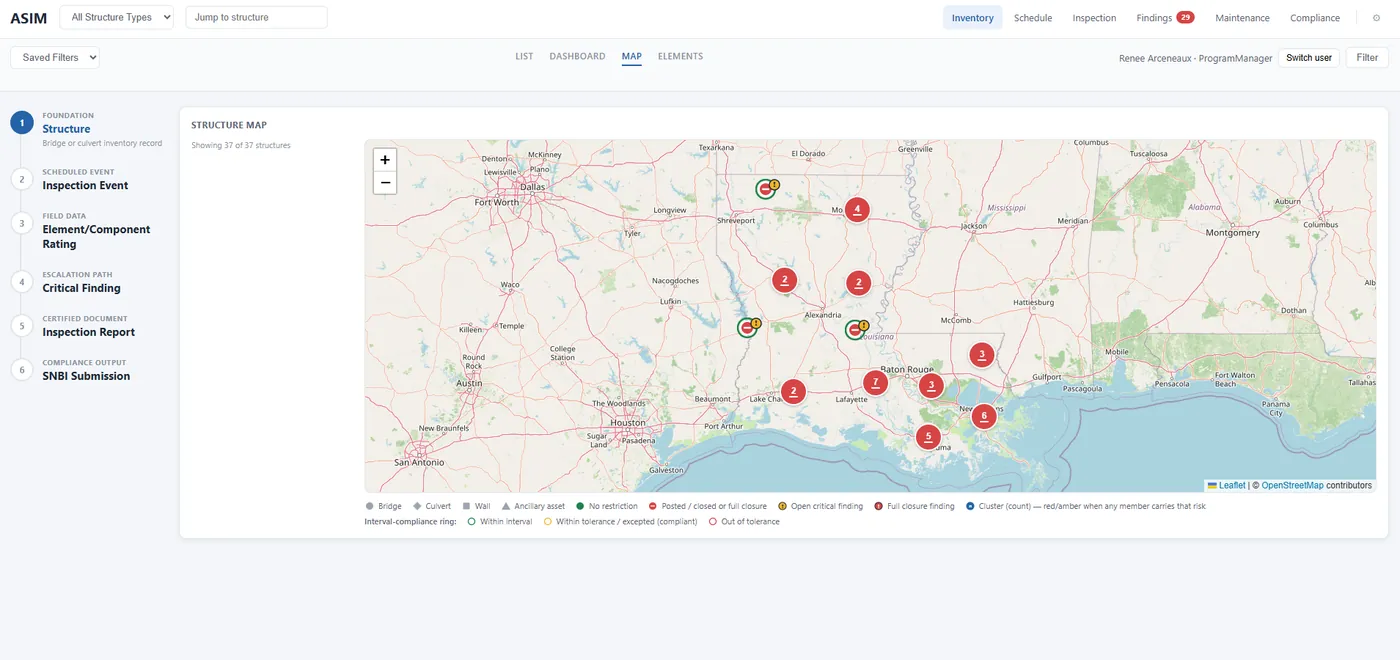
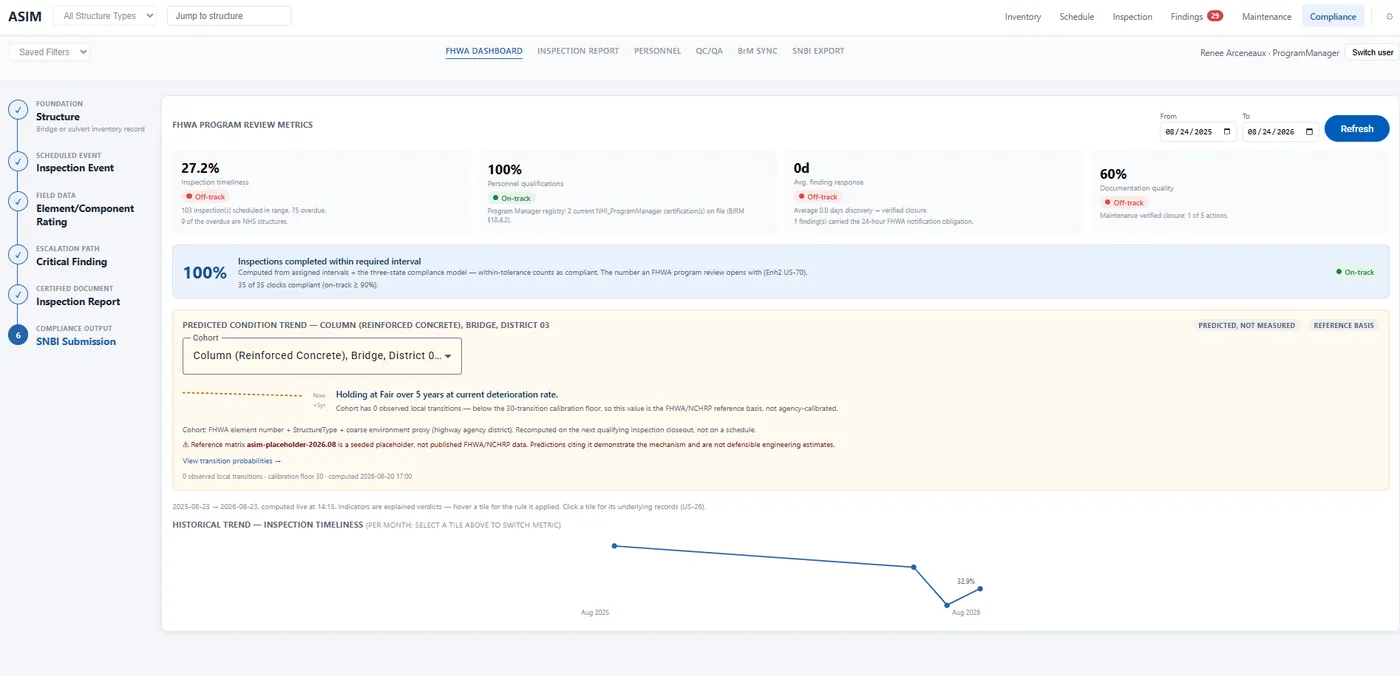
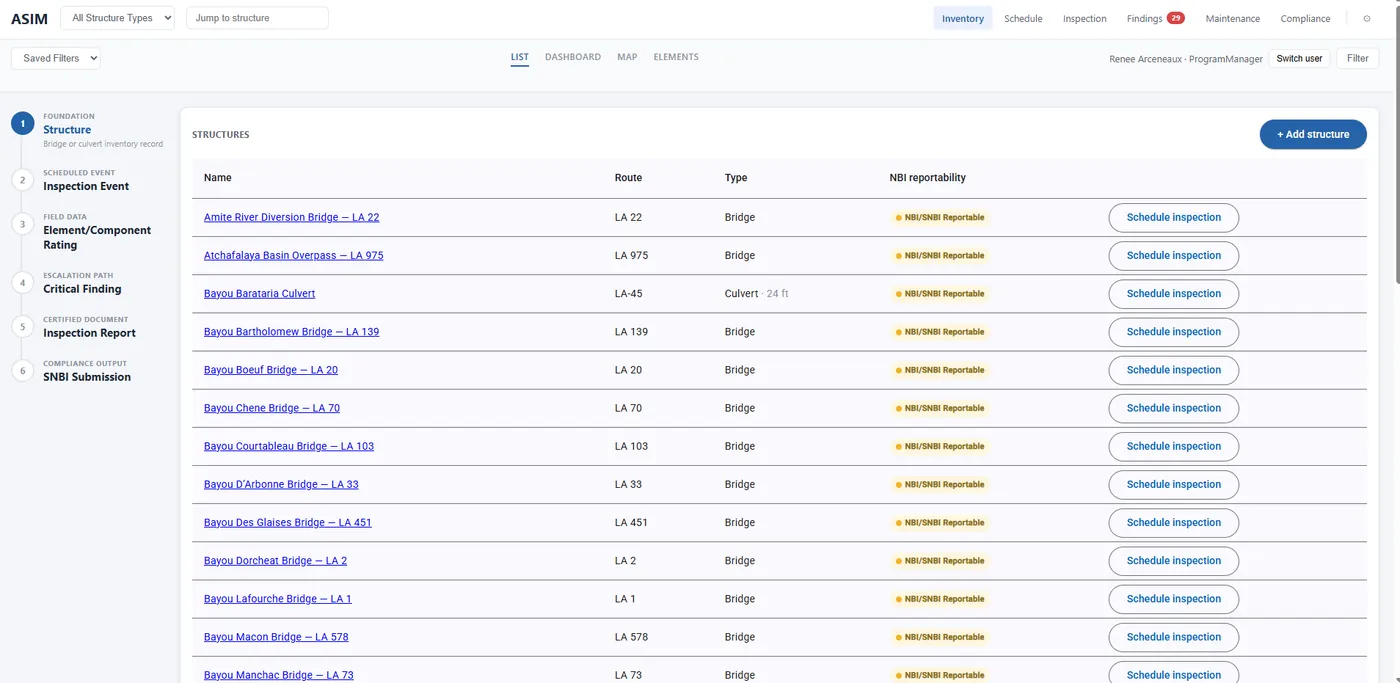
Structure inventory across bridges, culverts, walls and ancillary assets. Condition ratings and appraisal. Inspection interval compliance. Critical findings workflow. Scour appraisal with plan-of-action tracking. Load rating and posting decisions behind an enforced authorization gate. Inspector qualification as a hard gate, not a warning. Independent QC and QA review, separated architecturally. A federal program-review dashboard covering all 23 metrics. GIS mapping. Maintenance and work tracking. Deterioration forecasting. Crew routing and scheduling.
Plus a mobile field app — photolog with defect association, non-destructive sketch markup that never alters the original photo, and validation in the field before anything syncs.
How it went.
Two weeks. Eight hours of human direction.
Built in slices. Each one ran against the same codebase and was reviewed before the next began.
The eight hours are the part worth sitting with. That’s not a team’s time compressed — that’s the total human involvement. The system did the producing. A person decided what got produced, and checked it.
What it changed.
Thirty-nine capabilities tracked against the established products in the category. Twenty-seven delivered, seven partial, five deliberately not built.
Three of them go past parity:
The posting authorization gate is enforced, not a role label. The system will not let an unauthorized posting decision through.
QC and QA separation is architectural, not procedural. Independent review isn’t a checkbox someone can skip under deadline.
Deterioration predictions work from day one, seeded from reference data. Competing systems need years of an agency’s own inspection history before they can forecast anything.
What we chose not to build.
Not everything was attempted, and the reasons matter more than the list.
Offline field sync. The design questions weren’t resolved, and shipping half an answer to a problem inspectors depend on in the field would have been worse than not shipping it.
Network-level project optimization and budget scenario modeling. The established product has spent a decade tuning this. Chasing it would have produced a weaker version of something that already works.
Live integration with the incumbent system. The full integration path is built and proven against a mock service — authentication, push, pull, failure and retry. It has never run against the real system, because no license or tenant exists. Saying otherwise would be a claim we can’t stand behind.
The in-app coding guide excludes federal rating text. There was no honest source for it in-house, so it isn’t there.
Where it is now.
Runs locally, end to end. The cloud target was deliberately left open rather than decided early.